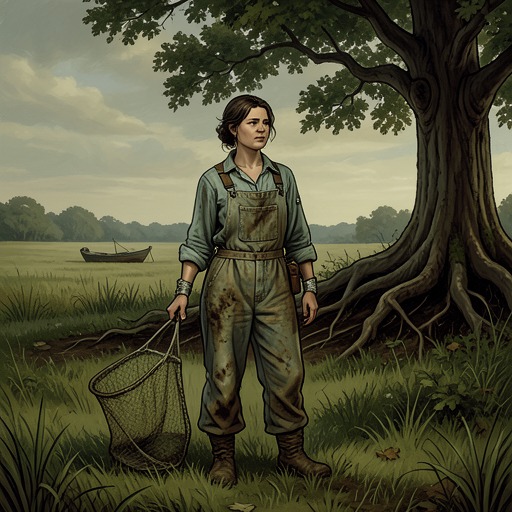
Julienne Maria Jacques
Where the Crawdads SingJulienne Maria Jacques, called Ma by her children, is Kya Clark’s mother and the household’s principal source of warmth, care, and everyday order. Her departure from the family’s shack turns that familiar presence into an absence Kya cannot explain: the child watches her go with a blue case and waits for her return. Later glimpses of Ma’s letter, artwork, and proper name complicate that loss, giving Kya pieces of a family history she had nearly forgotten.
Identity and Family Background
For much of Kya’s childhood, her mother is known simply as Ma. Kya does not learn her parents’ proper names until she opens the family Bible and reads that Mister Jackson Henry Clark married Miss Julienne Maria Jacques on June 12, 1933. The discovery gives names to the adults she has known through intimate routines and painful family circumstances. It also restores the names of Kya’s older siblings, whom she had struggled to remember, making the Bible a record of a family life that separation had obscured.
The narrative offers a brief earlier picture of Ma as a young woman. In Asheville, Jake Clark saw Maria Jacques, described as beautiful, with black curls and red lips, while she was visiting from New Orleans. Over a milkshake, he told her that his family owned a plantation and that he planned to study law after high school and live in a columned mansion. Those ambitions were not fulfilled: after the family arrived at the marsh, Jake did not finish high school and began drinking and gambling at Swamp Guinea. The contrast between his promise and their later circumstances frames the life Ma had to make in the home they actually occupied.
Making a Home
Ma’s care is shown through practical labor as much as through affection. She found sheets at rummage sales for the children’s floor mattresses and bought a stand-alone tin bathtub. She washed clothes at the yard spigot, worked out how to plant a garden, and kept chickens. The details make her domestic work visible: a home in the rough-cut shack was not simply there for the family but was assembled and maintained through her effort.
She also tried to secure an education for the children, hiking them to Barkley Cove in their best clothes to register them for school. Jake dismissed the value of schooling and often told Murph and Jodie to stay home and find squirrels or fish for supper. This conflict places Ma’s attempt to connect her children with the town’s formal institutions against Jake’s immediate demands for food and his disregard for education. The account does not give Ma’s thoughts about that opposition, but it establishes the unequal conditions under which she cared for the family.
For Kya, Ma’s presence is especially bound to repeated morning rituals. Ma hugged her, called her “my special girl,” and moved with her through the chores. She sang folk songs, recited nursery rhymes, and sometimes swung Kya into a jitterbug across the plywood floor until the battery radio fell silent. On other mornings she spoke about adult matters that Kya could not understand. Kya nevertheless listened, sensing that Ma’s words needed somewhere to go. These memories present mother and daughter not only as caregiver and child but as companions sharing work, language, music, and physical movement.
Leaving the Shack
The departure that Kya remembers begins on an August-hot morning in 1952. Six-year-old Kya is scrubbing grits from a pot when the screen door slaps. She knows the sound is wrong for Ma, who never let the door slam, and goes out to the porch. There she sees her mother walking down the sandy lane in her only pair of going-out shoes: fake-alligator heels beneath a long brown skirt. Ma also carries a blue train case, unlike her usual trips, when she might return with meat wrapped in brown paper or a chicken.
Ma usually looked back and waved where the foot lane met the road. This time she continues on, unsteady in the ruts, intermittently visible through the forest until only flashes of her white scarf remain. Kya runs to the place where the road should be visible, but arrives only in time to glimpse the blue case disappearing. The object’s striking color, remembered against the woods, makes the departure concrete; the wave Kya expects never comes. She returns to the steps with a heaviness in her chest and waits.
The household changes immediately. Kya’s older sisters make supper, but nobody sits at the table as they would have when Ma was there. Kya cannot eat and keeps watch down the lane. At night, frogs overwhelm the sounds she is listening for, but she lies on her porch bed trying to hear footsteps. The contrast with that morning’s shared cooking and dancing shows what has vanished: not only Ma herself, but the rhythms through which Kya had known home.
Memory, Letter, and Legacy
Kya continues to look down the lane for her mother long after the departure, imagining that Ma might return in the same fake-alligator heels. This hope persists even as Kya remembers Jake’s violence. He beat the family, mostly when drunk; Kya recalls him shoving Ma against the kitchen wall and hitting her until she slumped, and remembers that when she tried to intervene, he turned on her and whipped her. The account does not explain why Ma left or what she intended to do. For Kya, the painful contradiction is that the parent who had made daily life tender is gone, while the violent parent remains; she still imagines that the family might begin again if Ma came home.
The memories Kya retains are sensory and particular: Ma’s full red lips as she sang to the radio, her voice correcting Kya’s speech, and her paintings of estuaries and sunsets. Ma had brought art supplies and bought more at Kress’s Five and Dime; she sometimes let Kya paint on brown paper bags from the Piggly Wiggly. That permission gives Kya an early connection to making images, while the paintings preserve another view of Ma—as an artist attentive to the marsh landscape, not only the person who kept the household running.
In early September of the fishing summer, Kya finds a blue envelope addressed in Ma’s neat handwriting in the mailbox at the end of the lane. After so long without any trace, the letter confirms to Kya that Ma is alive and living somewhere else. Kya studies the slanted script and holds the envelope to the light, but can identify only her own name—and it is not on the outside. She does not open it; instead, because Jake is away in the boat, she props it against the saltshaker for him to see and watches it while cooking. The letter brings proof of life without an explanation or reunion, renewing Kya’s questions rather than resolving them.
Ma’s significance in Kya’s story lies in this unresolved combination of remembered intimacy and absence. Her gestures, songs, household work, and paintings remain vivid, while the reason for her departure and the contents of her letter are not supplied in these scenes. The later discovery of her full name restores a formal identity to the mother Kya had known through daily closeness, but it cannot undo the years in which Kya waited for her along the lane.